
Written by Jamie Walker, Senior Sales Executive, Texas Direct Roofing & Construction. Reviewed by Ryan Stephens, Director of Marketing. Updated November 2026.
TL;DR: Get a free roof inspection before you call your insurance, so you know whether the damage costs more than your deductible. Document everything, file quickly (many Texas policies give you one year from the storm, some less), and make sure the roofer is there when the adjuster inspects. Texas law gives your insurance carrier 15 days to acknowledge the claim, 15 business days to accept or deny once it has everything it asked for, and 5 business days to pay. You must pay your own deductible; any roofer who offers to cover it is breaking state law.
If you own a home in Dallas–Fort Worth or San Antonio, a hail claim is a question of when, not if. The process itself isn’t that hard, but small mistakes cost homeowners real money every year: filing before anyone has looked at the roof, missing a reporting deadline buried in the policy, or cashing the first check without checking what the estimate left out.
We’ve managed more than 2,400 insurance-claim roof replacements across Texas since 2017. This guide is the very process we walk our own customers through, with the Texas-specific deadlines and laws that most national guides skip.
Before You File: Three Questions to Answer First
A claim is worth filing when there is real hail damage, the cost to fix it is well above your deductible, and you are still inside your policy’s reporting window. Answer these three questions before you pick up the phone.
1. Is it actually hail damage?
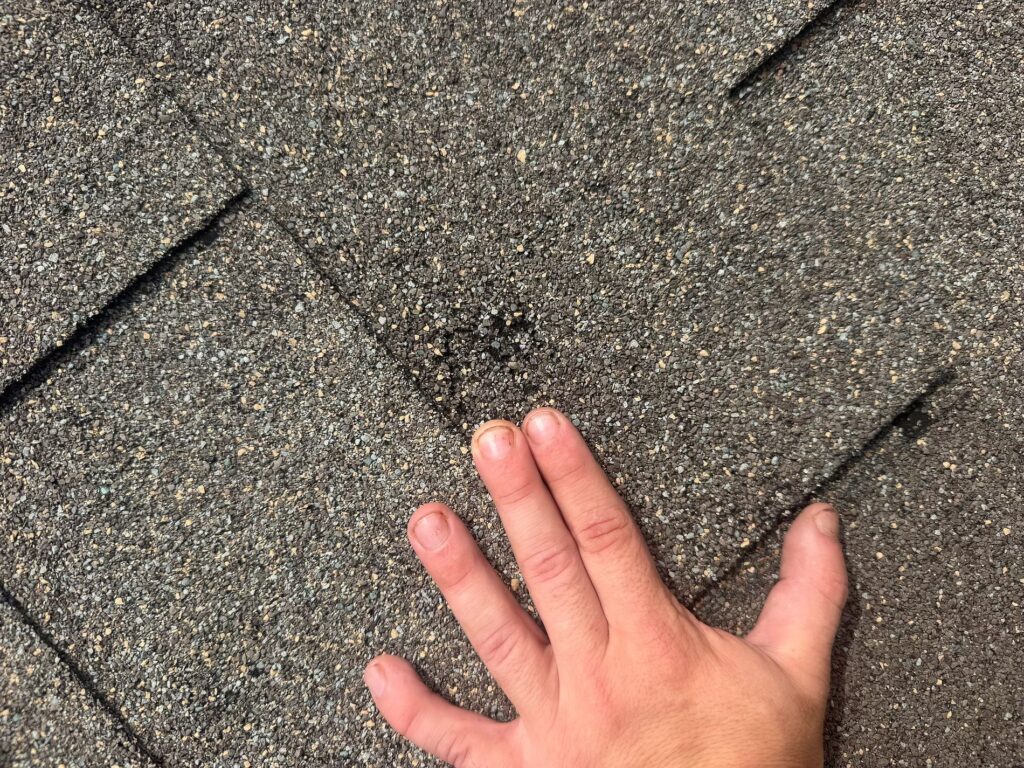
Hail leaves recognizable damage. From the ground, look for dents in gutters, downspouts, roof vents and AC condenser fins, plus chipped paint on fences and window trim. On the roof itself, a trained inspector looks for:
- Dark bruises where granules have been knocked loose, often soft to the touch
- Cracked or fractured shingles, especially on ridge caps, which take the most direct hits
- Granules collected in gutters or at downspout outlets
- Dings in metal flashing, pipe jacks and turtle vents
Wear and tear, blistering from heat, and bad installation look different, and adjusters look for it. That difference decides most claims, which is why the inspection comes first.
2. Is the damage bigger than your deductible?
Most Texas homeowners now carry a percentage-based wind and hail deductible, commonly 1% to 2% of the home’s dwelling coverage. On a home insured for $400,000, a 2% deductible is $8,000. If the repair costs less than that, insurance pays nothing, and you are better off paying for a retail, AKA out of pocket, repair or replacement.
3. Are you still inside the deadline?
Many Texas policies require you to report hail damage within one year of the storm, and some carriers have added endorsements with shorter windows. Courts have enforced these clauses. If you aren’t sure of the storm date, a hail map or National Weather Service storm report for your ZIP code will narrow it down. Check your policy’s declarations page and endorsements, or ask your agent.
How to File a Hail Damage Roof Claim in Texas: 8 Steps
- Stop further damage. Tarp any holes, cover broken windows, and remove standing water. Keep every receipt; most policies pay for reasonable temporary repairs, and the Texas Department of Insurance (TDI) recommends doing this right away. Don’t make permanent repairs before the adjuster sees the roof.
- Get a professional roof inspection. A free inspection from a local, licensed roofer tells you whether you have a claim before it goes on your insurance record. Ask for a written report with slope-by-slope photos, marked hail hits and collateral damage.
- Document everything yourself. Photograph and video the roof, gutters, siding, windows, fence, AC unit and any interior water stains. Write down the date and time of the storm. Don’t throw away damaged items until your insurer says you can.
- Read your policy. Find four things: your wind and hail deductible (flat or percentage), whether the roof is covered at replacement cost (RCV) or actual cash value (ACV), any roof-age or cosmetic-damage endorsements, and the deadline to report a loss.
- File the claim. Call your carrier or use its app. Give the storm date, your address, and a short factual description of what you found. Write down your claim number, and keep a log of every person you speak with, the date, and what was said.
- Meet the adjuster on the roof. Be home for the inspection and have your roofer there. Your roofer can point out damage and measurements the adjuster might miss. Under Texas law, though, your roofer cannot negotiate the claim for you; only you, a licensed public adjuster or an attorney can do that.
- Review the estimate line by line. Most adjusters write estimates in Xactimate. Compare it to your roofer’s scope: drip edge, starter strip, ridge cap, underlayment, valley metal, pipe jacks, vents, gutters, code-required items and overhead and profit are the usual misses. Missing items are added through a supplement, not a new claim.
- Complete the work and collect the rest. Pay your deductible, have the roof replaced, and send the final invoice to your insurer. On an RCV policy, that invoice releases the recoverable depreciation, the second check most homeowners are owed.
Texas Hail Claim Deadlines: The 15-15-5 Rule and Yours
The Texas Prompt Payment of Claims Act (Texas Insurance Code Chapter 542) sets hard deadlines for your insurer, often remembered as 15-15-5. You have deadlines too, and missing yours can end a valid claim.
| Deadline | Who it applies to | Time limit | Source |
|---|---|---|---|
| Acknowledge the claim, start the investigation, request what it needs | Insurer | 15 days after notice of claim | Ins. Code §542.055 |
| Accept or reject the claim in writing | Insurer | 15 business days after receiving everything it requested (can extend up to 45 days with written notice and reasons) | Ins. Code §542.056 |
| Pay an accepted claim | Insurer | 5 business days after accepting it | Ins. Code §542.057 |
| Extra time after a declared weather catastrophe | Insurer | All deadlines above extended 15 days | IIAT summary |
| Report the damage | You | Set by your policy; often 1 year from the storm, sometimes less | Your policy |
| Report the damage (coastal TWIA policies) | You | 1 year from the damage, by state law | Ins. Code §2210.573 |
| Written notice before suing over a hail claim | You | At least 61 days before filing suit | Ins. Code §542A.003 |
| File a lawsuit | You | Set by your policy; commonly 2 years and 1 day from the date of loss | Your policy |
Surplus lines insurers get longer windows: 30 business days to acknowledge and 20 days to pay. If an insurer misses its deadlines, it can owe penalty interest on top of the claim, though weather claims are calculated at a lower rate than other claims.
This section is general information, not legal advice. For a disputed claim, talk to a Texas insurance attorney.
How Your Insurer Pays: Deductibles, RCV, ACV and Depreciation
How much you get depends less on the storm and more on two lines in your policy: the deductible and whether your roof is covered at replacement cost or actual cash value.
Replacement cost value (RCV) pays what it costs to put a new roof on today, minus your deductible. It usually arrives in two checks. The first is the actual cash value minus your deductible. The insurer holds back the depreciation until the work is done and you send the final invoice.
Actual cash value (ACV) pays the depreciated value of your old roof. The depreciation is not paid back, so you cover it plus your deductible. Many Texas carriers now write ACV-only coverage on older roofs, so check yours before a storm.
| Example: 2% deductible on a $350,000 home | RCV policy | ACV policy |
|---|---|---|
| Full replacement cost | $20,000 | $20,000 |
| Depreciation on a 12-year-old roof | $7,000 | $7,000 |
| Deductible (you pay) | $7,000 | $7,000 |
| First check | $6,000 | $6,000 |
| Second check after work is complete | $7,000 | $0 |
| Total paid by insurance | $13,000 | $6,000 |
Figures are illustrative; your depreciation and deductible will differ.
Two more things to expect. If you have a mortgage, the check is often made out to you and your lender, and the lender may hold funds until the work is inspected. And Texas law requires you to pay your full deductible; your insurer can ask for proof, such as a canceled check or a financing agreement.
What to Do If Your Hail Claim Is Denied or Underpaid
A denial or a low estimate is not the end of the claim. When an insurer rejects a claim in Texas, it has to tell you why in writing, and that reason tells you which option fits.
Common reasons Texas hail claims get denied or cut:
- “Wear and tear” or age-related deterioration instead of storm damage
- Cosmetic damage only, on policies with a cosmetic-damage exclusion
- Late notice, past the policy’s reporting window
- Damage that predates the policy or the storm date on the claim
- Damage that falls under the deductible
Your options, roughly in this order:
- Request a reinspection. Ask for a second adjuster visit with your roofer present, and bring the inspection photos.
- File a supplement. For an underpaid claim, your roofer documents the missing line items and you submit them to the adjuster.
- Invoke appraisal. Most Texas policies have an appraisal clause for disputes over the amount of loss, not over whether something is covered. Each side hires an appraiser, and they pick an umpire to settle disagreements.
- File a complaint with TDI. Call 800-252-3439 or file online. It creates an official record and can push a slow insurer to act.
- Bring in a licensed public adjuster or an attorney. For large or bad-faith disputes, an attorney must send the 61-day written notice before filing suit over a hail claim.
Storm Chaser Red Flags: Texas Laws That Protect You
After every big DFW hailstorm, out-of-town crews knock on doors. Texas has no statewide roofing license, so the law and a little homework are your best protection.
- “We’ll cover your deductible.” Illegal. Texas law requires policyholders to pay their deductible, and Business and Commerce Code §27.02 bars contractors from waiving, paying or rebating it. Since 2019, violators face up to a $2,000 fine and up to 180 days in jail, and the homeowner can be on the hook too.
- “We’ll handle your claim and negotiate with the insurance company.” A contractor working on your home is prohibited from acting as your public adjuster under Insurance Code §4102.163.
- No deductible notice in the contract. Any Texas contract over $1,000 that will be paid with insurance money must include a bolded notice that you’re required to pay your deductible. Its absence is a warning sign.
- Pressure to sign before the inspection, or a demand for full payment upfront.
- No local address, no reviews, no verifiable credentials. Look for a Roofing Contractors Association of Texas (RCAT) license, a BBB profile, and manufacturer certifications you can verify on the manufacturer’s site.
If a contractor offers to waive your deductible, report them to the Texas Attorney General’s consumer protection hotline at 800-621-0508.
Texas Direct Roofing & Construction holds RCAT license 01-0501, is an Owens Corning Platinum Preferred contractor, and has been headquartered in Hurst since 2017.
Use Your Claim to Upgrade to a Class 4 Roof
A hail claim is often the cheapest moment you’ll ever have to upgrade your roof. Insurance pays to replace what you had; you pay only the difference to step up to impact-resistant shingles.
Class 4 is the top rating under the UL 2218 impact test. TDI recognizes Class 1 through Class 4 roofing for premium credits, with Class 4 earning the highest, and each insurer sets its own discount amount. After installation, your roofer fills out TDI Form PC068, the impact-resistant roofing installation form, which you send to your agent to request the credit.
Call your agent before you sign the contract and ask for the dollar amount of the Class 4 discount on your policy. That number tells you how fast the upgrade pays for itself.
Popular Class 4 options in DFW include Owens Corning Duration STORM and polymer shingles like F-Wave, which we install as a certified contractor.
Texas Hail Damage Roof Claim FAQs
How long do I have to file a hail damage roof claim in Texas?
It depends on your policy. Many Texas homeowners policies require you to report hail damage within one year of the storm, and some set shorter windows. Coastal TWIA policyholders have one year by state law. Report as soon as you know about the damage.
Should I call my insurance company or a roofer first?
A roofer first. A free inspection tells you whether you have storm damage and whether it’s larger than your deductible, before a claim is on your record. If the damage is real, file right away.
Will filing a hail claim raise my insurance rates?
A single weather claim is generally treated differently from claims you could have prevented, but carriers vary, and multiple claims in a few years can affect renewal. Ask your agent how your carrier handles weather claims.
Can my roofer talk to the insurance adjuster for me?
Your roofer can meet the adjuster, show the damage and submit documentation and supplements. A contractor working on your home cannot legally negotiate the claim on your behalf in Texas.
Can a roofer pay or waive my deductible in Texas?
No. Texas law requires you to pay your deductible, and contractors who waive, rebate or absorb it face fines and possible jail time.
How long does the insurance company have to pay my hail claim?
After accepting your claim, a Texas insurer generally has 5 business days to pay. It has 15 days to acknowledge your claim and 15 business days to accept or reject it once it has everything it asked for, plus 15 more days after a declared weather catastrophe.
What is recoverable depreciation?
On a replacement-cost policy, it’s the portion of the payout your insurer holds back until the roof is replaced. Send the final invoice when the work is done to receive it.
What if my insurer says the damage is only cosmetic?
Check whether your policy has a cosmetic-damage exclusion. If it doesn’t, or you believe the damage affects how the roof performs, request a reinspection with your roofer present, or consider appraisal or a public adjuster.
Get a Free Hail Damage Inspection
Not sure whether that last storm damaged your roof? Texas Direct Roofing & Construction offers free, no-obligation roof inspections across Dallas–Fort Worth. We’ll document what we find, tell you honestly whether a claim makes sense, and meet your adjuster if you file.
Call (817) 775-3540 or request your free inspection.
Publishing Notes (not part of the published post)
Internal links
| Anchor text | Link to | Where in the post |
|---|---|---|
| free roof inspection | /roof-inspection/ (pillar) | Step 2 and the CTA |
| why insurance won’t cover your roof | Policy pitfalls post | Denied claims section |
| how long a DFW roof lasts | Roof lifespan post | ACV paragraph |
| fall hail season | El Niño post | “Are you still inside the deadline?” |
| F-Wave | F-Wave review | Class 4 section |
| emergency tarping | /roofing/#tarping | Step 1 |
Add links pointing to this post from the roof inspection pillar, the homepage storm-damage copy, and the 2025 insurance roof replacement post. That older post targets nearly the same query: either 301 it here or rewrite it around a different angle so the two don’t compete.
Checklist
- Swap in real TXD photos: hail bruise close-up, chalked test square, dented vent, a crew meeting an adjuster (alt text with “hail damage roof”)
- Confirm Jamie as author and Ryan as reviewer, with bio links
- Add FAQPage schema from the 8 FAQs and Article schema with author and reviewer
- Place the TL;DR above the fold and the deadlines table high enough to be seen without much scrolling
- File under a new “Insurance Claims” category
- Have an attorney or licensed adjuster you work with sanity-check the deadlines table before publishing
- Set a reminder to review after the 2027 Texas legislative session
Sources
- TDI: Hail damage tips to file an insurance claim
- TDI: Roofing and insurance, know the law
- TDI: State law cracks down on roof scams
- TDI: Roofing discounts
- TDI Form PC068
- IIAT: Prompt payment of claims
- GoSuits: Texas Prompt Payment of Claims Act
- Reyes Law: How long insurers have to pay claims in Texas
- Mondaq: Texas Hail Bill 61-day notice
- MDJW: Court enforces one-year hail reporting endorsement
- TDI: TWIA one-year claim-filing deadline rule
- Roofing Contractor: Texas deductible waiver penalties
- CRS Roofer: Texas deductible ranges